

According to management guru Peter Drucker, “You can’t manage what you can’t measure.” This is undoubtedly true for passenger flow management, and as measurement technologies are evolving, LiDAR tracking appears to be the leading approach. With outstanding precision, LiDAR sensors enable the most accurate measurement of passenger position and movement.
Passenger processing performance can be accurately measured, managed, and continuously improved with this precise information. LiDAR sensors can cover longer distances and broader areas, making it possible to measure passenger flows in large airport concourses with just a few sensors, compared to the multiple camera devices required to cover the same area. Measurement is not only more precise, but the overall cost of implementation and ownership is also lower.
Detect, classify & track
The Passenger Flow Measurement solution utilizes AMORPH.senses technology to process LiDAR data, enabling the detection, classification, and tracking of objects such as passengers and bags.
Dynamically formed queues are automatically detected and associated with specific processing points to provide the most accurate service quality measurements. Thus, invalid queue measurements due to dependence on preconfigured queuing areas are eliminated. Another significant advantage of this LiDAR-based solution is that passengers can be tracked anonymously, providing total GDPR compliance.
Further cost advantages are possible with the ability to install WiFi-capable edge devices to receive the LiDAR data. Therefore, cable installation costs can be avoided, and implementation time can be substantially reduced. This also makes it viable to have temporary installations for specific purposes, such as analyzing passenger behavior in response to new or modified processes.
Tracking passengers with the AMORPH.senses LiDAR solution provides a measurement method that is flexible, cost-effective, fully GDPR compliant, and offers exceptional capability for Passenger Flow Management.
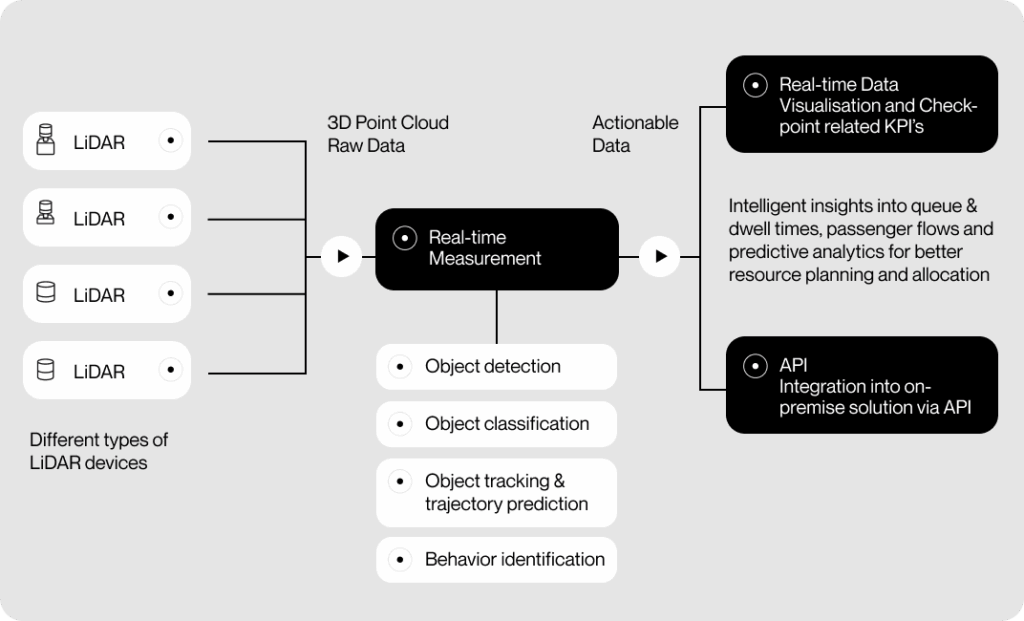
Supported features include:
- Any object detection and classification. Apart from people, objects like bags, or motor vehicles can be detected, classified, and tracked.
- Anonymized object tracking. Unlike camera-based solutions, no personally identifiable data is captured using LiDAR sensors.
- Unstructured/dynamic queue detection. Queues are automatically detected based on people’s behaviour and predefined queueing areas are not required.
- Volume & velocity measurement. As objects are continuously tracked, the volume in a specific area as well as the velocity of moving objects can be determined.
- Trajectory prediction. Processing of movement characteristics to predict the path that tracked objects will follow.
- Area coverage with fewer devices. Large areas can be covered due to long range capability and wide vertical and horizontal fields of view.
- Mesh design for unlimited area sizes. With a sensor mesh objects can be continuously tracked across multiple sensors.
- Less infrastructure with a WiFi connection. With WiFi connectivity capability tracking can be implemented without the need for expensive cabling.
- Sensor-supplier independent. Amorph.senses perception software enables the best sensor to be used for a given use case.
- Minimized use of sensors with Long-range coverage. LiDAR sensors can cover longer distances.
- Uninterrupted measurement in all lighting conditions. The use of laser beams enables effective use in any lighting conditions.